
Savannah's beauty comes wrapped in moisture. The same warm, heavy air that drapes Spanish moss over the live oaks and keeps the squares lush year-round also settles into every gutter on every home in the city. Most homeowners think about humidity in terms of comfort, not maintenance.
Up on the roofline, though, that constant dampness changes how gutters age, clog, and fail. The effects are slow and easy to overlook, which is exactly why so many coastal homeowners are caught off guard by problems their inland friends rarely face.
Why the Coast Plays by Different Rules
Gutters in a dry climate get a chance to bake out between rains, but Savannah rarely offers that reprieve. The air itself holds enough moisture that debris inside a trough stays damp for days even when no rain has fallen. Constant humidity keeps organic matter wet, which means it decays in place rather than drying out and blowing away. In the Ardsley Park neighborhood, leaf litter that would crumble to dust inland instead turns to a soft, persistent mulch.
That single difference drives almost everything else. Wet debris breaks down into sludge far faster, and sludge is what actually blocks the flow and clings to the metal.
Coastal downpours also punish the vertical half of the system, and why your downspouts matter more than your gutters during Georgia storms covers that half in full.
The Moisture Your Gutters Never Get to Shed
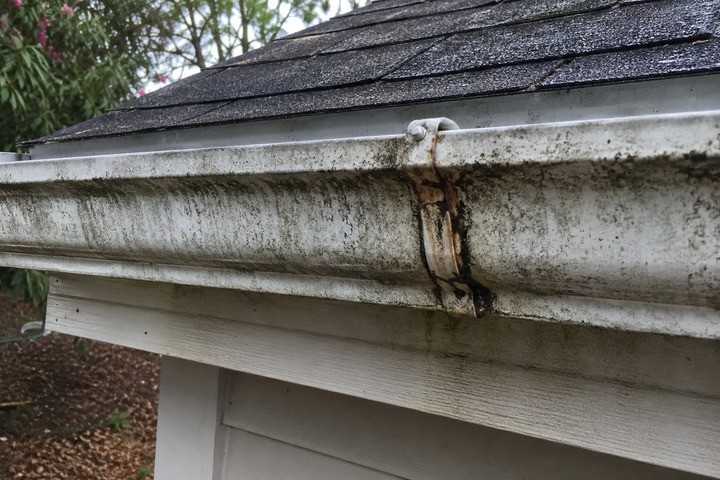
A gutter is built to fill and then empty, but humidity interferes with the emptying half of that cycle. Fine sediment at the bottom of the channel holds water like a wick, staying saturated long after the visible runoff is gone. Trapped dampness sits against the seams where panels join, which is the first place a coastal gutter tends to give out. Homes in Savannah's Historic District, many with decades-old systems, show this wear at the corners and joints first.
The roof edge suffers too when water lingers where it should not. Persistent moisture at the fascia can soften the wood behind the gutter, a problem that stays hidden until a board finally goes spongy.
Organic Growth That Loves a Humid Trough
Few environments suit mold, mildew, and weeds better than a warm gutter that never fully dries. Spores settle into the damp sediment and take hold fast, and on Wilmington Island it is common to find small gardens of weeds rooted right in the troughs. Living growth like this traps even more debris and moisture, compounding the blockage with every passing week. Spanish moss fragments add to the mix, dropping in from nearby oaks and knitting the whole mass together.
What starts as a thin green film can become a dense, root-bound plug. Vegetation in the gutters is a clear sign the system has been holding water far longer than it should.
What Salt Air Quietly Adds
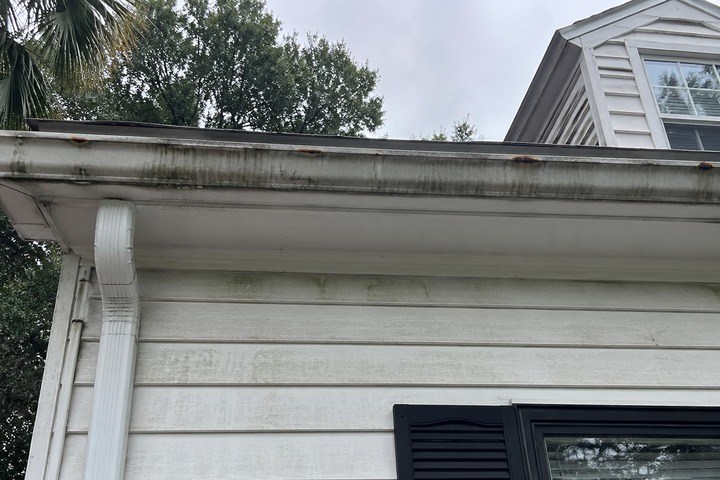
Proximity to the marshes and the ocean means coastal gutters contend with something inland homes never do. Salt carried on the breeze settles onto and into the metal, and in the presence of constant humidity it speeds up corrosion considerably. Salt and moisture together attack seams, fasteners, and any spot where the protective coating has worn thin. On Tybee Island, where homes sit closest to the water, this accelerated wear is simply part of owning a house.
The damage often appears first as rust streaks or small pinhole leaks. Early corrosion is far cheaper to address than the full section replacement that follows years of neglect.
| Factor | Effect |
|---|---|
| Salt + humidity | Speeds corrosion considerably |
| Attack points | Seams, fasteners, worn coatings |
| Early sign | Rust streaks or pinhole leaks |
| Tybee Island homes | Face fastest accelerated wear |
| Early fix | Cheaper than full section replacement |
Standing Water and the Pests It Invites
A clogged, humid gutter does more than threaten the house; it builds an ideal nursery for insects. Water that cannot drain settles in the low spots and becomes a breeding pool within days, and Savannah's long warm season keeps that cycle running for most of the year. Stagnant gutter water is one of the most overlooked mosquito sources around a coastal home. A homeowner in Pooler battling a stubborn backyard mosquito problem may never think to look up at the roofline.
Clearing the blockage removes the water, and removing the water removes the nursery. Free-flowing gutters simply do not hold the standing pools that pests depend on.
Humidity is the slow threat on the coast. The fast one arrives with a name, and hurricane season gutter prep for coastal Georgia homes covers how to get ahead of it.
The Maintenance Rhythm a Humid Climate Demands
Inland homeowners can sometimes stretch a year between cleanings, but the coast rewards a closer watch. Because debris decays into sludge so quickly here, the system benefits from being cleared before that breakdown gets a head start. More frequent attention keeps the troughs from ever reaching the saturated, growth-friendly state humidity pushes them toward. Seasonal plans built for the climate account for this rather than treating Savannah like a dry inland town.
Timing the visits around the region's wettest stretches makes the biggest difference. A spring and fall cadence clears the buildup before the heaviest moisture and the autumn drop can combine against the gutters.
Water that sits that long does more than corrode. It starts breeding trouble, as we explain in how clogged gutters make mosquito problems worse around Georgia homes.
How the Network Keeps Coastal Gutters Honest
Humidity hides its damage inside seams and under sediment, so seeing the real condition matters more here than almost anywhere. Before-and-after photos document what came out and what the channels look like once cleared, giving coastal homeowners a true picture instead of a hopeful guess. A free satellite-based estimate maps the roof and gutter runs ahead of time, so the visit is planned around your specific layout.
Every cleaning the network arranges stands behind its work. The 45-day no-clog guarantee brings a vetted local pro back at no charge if a blockage returns soon after service, which is reassurance worth having in a climate this demanding.
Stay Ahead of the Coastal Damp
Savannah's humidity is not going anywhere, but the gutter problems it causes are entirely preventable with the right rhythm of care. Regular clearing keeps moisture, growth, salt, and pests from turning a slow climate disadvantage into an expensive repair. The key is acting before the dampness has time to do its quiet work.
If your coastal gutters are overdue, now is the moment to get ahead of them. Book a free estimate for residential gutter cleaning or commercial gutter cleaning, and consider gutter repair or downspout services if salt and moisture have already taken a toll.