
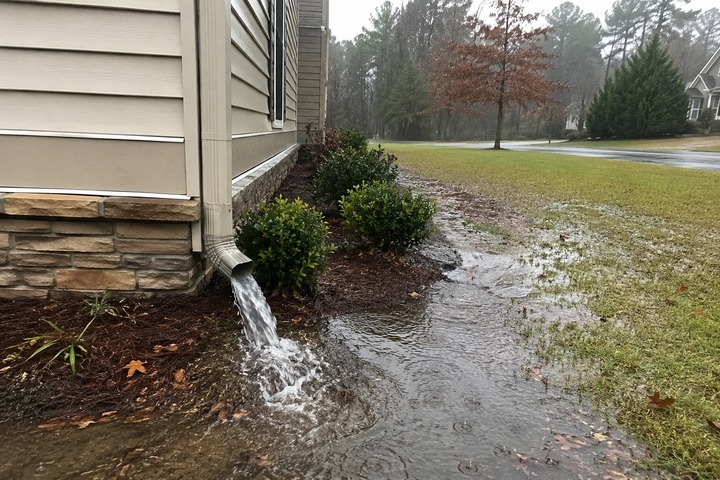
When a Georgia thunderstorm opens up, most homeowners watching water pour over the edge of their gutters blame the gutters. It is an understandable reaction, since the gutters are the part you can see filling and spilling. The real culprit, more often than not, is tucked at the corners of the house doing far more work than anyone gives it credit for.
Downspouts are the unglamorous vertical pipes that carry everything your gutters collect down and away from the home. During the kind of intense, fast rainfall Georgia is known for, they matter more than the troughs above them, and when they fail the consequences reach all the way to the foundation.
The Part of the System Everyone Forgets
Gutters get all the attention because they run along the roofline in plain view, while downspouts blend into the corners of the house. Yet every drop a gutter collects has to funnel through those narrow pipes to actually leave the property. The downspout is the bottleneck, the single point where a large volume of water is forced into a small opening. In Atlanta's Buckhead neighborhood, where large roofs shed enormous amounts of runoff, that bottleneck is tested with every serious storm.
Because they are out of sight, downspouts are also the part homeowners almost never check. A blockage can build for months at the top elbow or the bottom outlet without anyone noticing until the water has nowhere to go.
How Georgia Storms Overwhelm a Hidden Clog
Georgia does not get gentle, all-day rain so much as sudden, drenching downpours that dump an inch or more in a short window. That intensity is exactly what exposes a partly blocked downspout. A restricted pipe simply cannot pass water fast enough during a cloudburst, so the gutter above it backs up and overflows even though it is doing its job. A Decatur homeowner in the Oakhurst area might keep their gutters spotless and still watch sheets of water cascade off the front, baffled by the cause.
The harder it rains, the wider the gap between what the gutter delivers and what the downspout can accept. Storm-volume runoff turns a minor obstruction into a total failure in a matter of minutes.
The next big downpour is also a free diagnostic. Here is what Georgia's summer thunderstorms reveal about your gutters if you know where to look.
When a Clean Gutter Still Fails
This is the disconnect that frustrates so many homeowners. They invest in clearing the troughs, see them gleaming, and then watch the system overflow at the next storm anyway. The water never reached the ground because the path out was choked below the point they cleaned. In Sandy Springs, a clogged elbow joint at the top of a downspout is a frequent reason for overflow on an otherwise immaculate gutter.
Clearing the horizontal channel only solves half the problem if the vertical exit is plugged. The full path has to be open, from the trough through every elbow to the final discharge point, or the system backs up.
Discharge placement deserves its own conversation, so we wrote one: where downspouts should drain in Georgia's red clay yards.
Where That Water Actually Needs to Go
Getting water into the downspout is only the start; getting it far enough from the house is what protects the structure. A downspout that dumps right at the base of the wall sends thousands of gallons straight into the soil against the foundation. Discharge close to the house is one of the most common drainage mistakes seen across Georgia. In Augusta's National Hills, extensions that carry water several feet out into the yard make a dramatic difference during heavy rain.
The goal is to move runoff to where it can soak away harmlessly. Proper extensions and splash zones keep storm water from pooling where it can undermine the very base of the home.
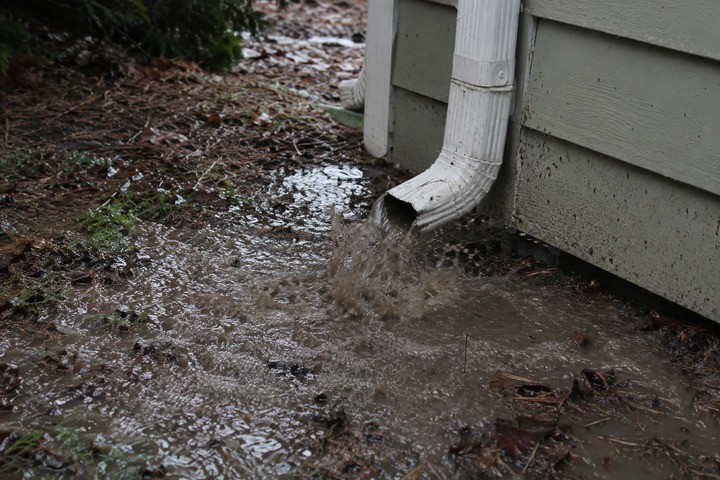
Every gallon a blocked elbow rejects ends up in the soil beside the house, and what happens when rainwater drains too close to your foundation shows what that costs.
| Practice | Result |
|---|---|
| Discharge at foundation | Water pools against home |
| Extension several feet out | Reduces pooling near foundation |
| Proper splash zone | Keeps runoff away from base |
| Water soaking away safely | Protects structure from damage |
Undersized for Georgia's Rainfall
Not every downspout failure is a clog; sometimes the pipe was simply never big enough for the climate. Many homes carry standard downspouts sized for average rainfall, not for the tropical-style deluges Georgia produces in summer. An undersized downspout chokes on volume the moment a real storm hits, regardless of how clean it is. Larger outlets or additional downspouts often solve overflow that no amount of cleaning could fix.
Matching the drainage to the rainfall is the part most people never consider. Capacity, not just cleanliness, determines whether a system can keep up when the sky truly opens.
Overflow also leaves fingerprints you can learn to read, decoded in the Georgia homeowner's guide to gutter sludge, roof grit, and black streaks.
Signs the Downspouts Are the Real Problem
A few patterns point straight to the vertical pipes rather than the troughs. Water overflowing at the corners nearest a downspout, rather than spilling evenly along the run, suggests the exit is the choke point. Overflow concentrated near an outlet is a classic downspout signature. A hollow, gurgling sound during rain is another, telling you water is struggling past a restriction inside the pipe.
Erosion or a small trench forming at the base of a downspout reveals a different issue, one of discharge rather than blockage. Soil washing away beneath an outlet means the water is landing where it should not.
How a Pro Tests and Clears the Whole Path
Diagnosing a downspout means following the water all the way through, not just glancing at the top. A thorough service flushes each pipe end to end to confirm nothing is lodged in the elbows or the underground run. Before-and-after photos capture the flow restored, so you can see the system actually carrying water rather than assume it. A free satellite-based estimate helps map how many downspouts a roof this size really needs.
Every job the network arranges is backed the same way. The 45-day no-clog guarantee brings a vetted local pro back at no charge if a blockage returns soon after the work is done.
Protect the Foundation, Not Just the Roofline
During a Georgia storm, the gutters may be the part you watch, but the downspouts are the part that decides whether your home stays dry. Clear, properly sized, well-aimed downspouts are what actually move storm water away from the structure where it belongs. Ignoring them while obsessing over the troughs leaves the most important job half done.
If overflow keeps happening despite clean gutters, the answer is almost certainly below. Look into the vertical side of the system with downspout services and gutter repair, and pair it with routine residential gutter cleaning or commercial gutter cleaning to keep the whole path flowing.