
Most gutter problems announce themselves long before they cause real damage, but only if you know what you are looking at. Three signs in particular tell the story of what is happening inside a Georgia gutter system: a layer of sludge, a scattering of dark grit, and streaks of black running down the front. Each one points to a different process at work.
Learning to read them turns a vague sense that something is off into a clear picture of what your gutters actually need. Here is what each sign means, why it shows up across Georgia homes, and what it takes to put things right.
Three Warning Signs, Three Different Causes
It is tempting to lump every bit of gutter gunk into one category and call it dirt, but the distinctions matter. Sludge, grit, and streaking each come from a separate source and call for a slightly different response. Reading them correctly is the difference between treating a symptom and addressing the cause. In Columbus's Wynnton neighborhood, homeowners who learn to tell them apart tend to catch problems far earlier.
None of the three is harmless, and all three are common right across the state. Together they form a kind of diagnostic language any homeowner can learn to read with a little guidance.
| Sign | Cause | What It Means |
|---|---|---|
| Sludge | Decomposed leaves, pollen, dust | Holds water, resists rinsing |
| Roof Grit | Shed asphalt shingle granules | Signals shingle wear |
| Black Streaks | Overflow of oxidized residue | Signals history of overflow |
Gutter Sludge, When Debris Becomes Paste
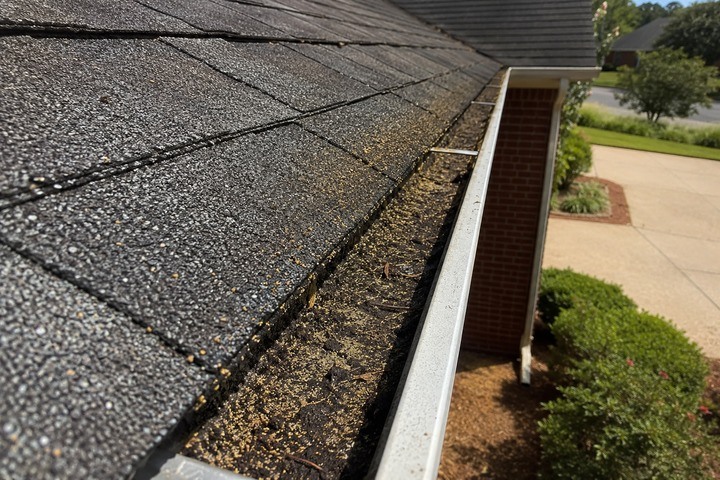
The dark, mucky layer at the bottom of a neglected trough is the end stage of organic debris. Leaves, pollen, seeds, and dust break down over months into a dense paste that holds water and resists rinsing. Sludge is fully decomposed debris, which is why it behaves more like wet mortar than like the leaves it started as. In Athens near Normaltown, shaded homes under heavy canopy build this layer faster than sunnier lots.
Its defining trait is how stubbornly it clings to the metal and to itself. Sludge will not blow out or flush away, so it has to be physically scooped and wiped from the channel.
Roof Grit, the Black Sand From Your Shingles
Run your hand along a sludge-free gutter and still find coarse dark granules, and you are looking at your roof's mineral surface. Asphalt shingles shed this grit steadily, and every rain carries a little more of it into the gutters. Roof grit signals shingle wear, so a heavy accumulation can be an early hint that the roof itself is aging. A Macon homeowner in Shirley Hills who finds growing piles of it may want the roof looked at, not just the gutters.
On its own, grit is more a symptom than a clog, but it adds up over time. Granules settle at the low points and contribute weight and mass to any blockage already forming there.
Heat and damp speed all of this up, and what Savannah's humidity does to gutters shows the coastal version of the same decay.
Black Streaks, the Stains That Will Not Wash Off
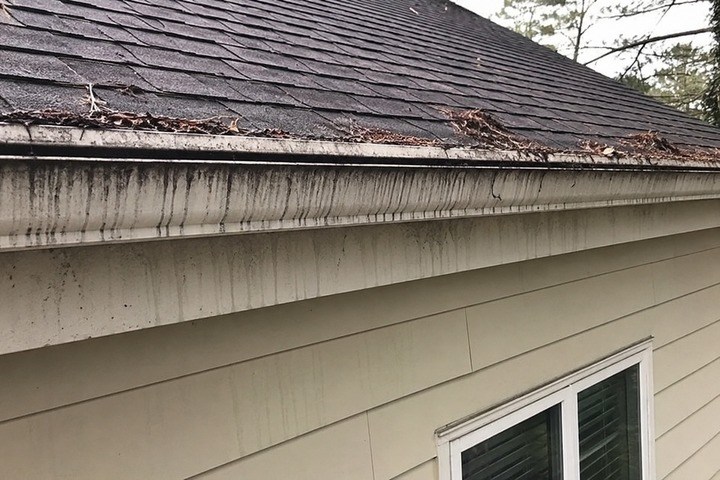
Those dark vertical stripes running down the face of a gutter have a name among professionals: tiger striping. They form when overflowing water carries oxidized residue and pollutants over the front lip, depositing them on the outside of the metal. Black streaking marks a history of overflow, telling you the gutter has been spilling rather than draining. In Atlanta's Grant Park, where many homes wear original gutters, this striping is a common sight on systems overdue for service.
The stains are notoriously resistant to a quick spray from the hose. Tiger striping needs dedicated cleaning, and more importantly it signals that the underlying overflow problem still needs solving.
Why These Problems Travel Together
Find one of the three and you will often find the other two nearby, because they feed one another. Sludge blocks the flow, the blockage causes overflow, and the overflow leaves the black streaks down the front. One problem accelerates the next, turning a slow buildup into a visible mess over a single wet season. Roof grit folds into the mix, bulking up the sludge and helping it hold even more water.
This is why patching a single symptom rarely lasts. The cycle has to be broken by clearing the whole system, not just scrubbing the part that shows. Homes in Roswell's Crabapple area that address all three at once stay clean far longer.
What You Can Check From the Ground
You can learn a surprising amount without ever climbing a ladder. Black streaks on the gutter face, plants sprouting above the roofline, and grit washed onto the driveway below a downspout are all visible from the yard. Ground-level clues can confirm that a problem exists, even if they cannot reveal its full extent. What you cannot see is the depth of sludge or the condition of the seams hidden inside the trough.
That blind spot is exactly where trouble compounds unseen. The inside of the channel tells the real story, and it can only be read from the roofline.
Wet sludge has one more side effect worth knowing: it is a nursery. How clogged gutters make mosquito problems worse explains why.
How a Pro Reads and Resolves the Signs
An experienced eye can look at the pattern of sludge, grit, and streaking and trace it back to the root cause quickly. A thorough cleaning clears the decomposed debris, flushes the grit, and removes the conditions that let streaking return. Before-and-after photos document each of the three signs resolved, so you can see the channels clean and the flow restored. A free satellite-based estimate sizes up the job before anyone sets foot on the property.
Every cleaning the network arranges carries a firm commitment. The 45-day no-clog guarantee means a vetted local pro returns at no charge if a blockage comes back soon after the visit.
Read the Signs Before They Cost You
Sludge, roof grit, and black streaks are not just cosmetic nuisances; they are your gutters telling you exactly what is wrong. Catching them early turns an easy maintenance visit into the whole solution, before overflow can stain the siding or water can reach the foundation. The longer the three are left to feed each other, the harder and costlier the fix becomes.
If any of these signs look familiar on your own home, it is worth a closer look. Start with a free estimate for residential gutter cleaning or commercial gutter cleaning, and explore gutter repair or downspout services if overflow has already left its mark.