
That earthy smell rising through the floor vents each November has a source most homeowners never think to check outside. Long before anyone notices a stain on the ceiling or a soft spot in the hallway, the trouble usually starts at the roofline, where water either moves away from the house or piles up right against it. In much of Georgia, where crawl space foundations are the norm rather than the exception, that difference matters more than people realize.
Understanding the path water takes from your roof to the ground under your house explains a lot about why basements smell musty and why hardwood floors start to warp even when nothing seems obviously wrong. It is a chain, and once you see how the links connect, the fix usually becomes obvious.
The Chain Reaction Beneath Your Feet
Start with an overflowing gutter during a heavy autumn storm. That water does not just disappear. It sheets off the edge of the roofline and lands in a narrow band right along the foundation wall. Do that enough times through a wet season, and the soil in that band becomes consistently saturated, holding far more moisture than the surrounding yard. From there, the water has nowhere to go but down, and often, inward, seeping toward the crawl space below.
This is the whole story in miniature. Overflow leads to saturated soil, saturated soil leads to rising vapor, and rising vapor leads to climbing moisture readings in the space under the house. None of it requires a dramatic leak or a cracked pipe. It just requires gutters that are not doing their job during the season when rain falls most often.
| Step | What Happens |
|---|---|
| Gutter overflow | Water sheets off roof near foundation |
| Soil saturation | Band along foundation stays wet |
| Vapor rises | Moisture seeps into crawl space |
| Moisture readings climb | Crawl space humidity increases |
Why Vented Crawl Spaces Are So Vulnerable
Most older homes across the state were built with vented crawl spaces, a design that made sense decades ago for keeping air moving underneath the structure. The problem is that vented crawl spaces breathe whatever moisture the surrounding soil offers, good or bad. When the soil near the foundation stays damp for weeks at a time, that dampness gets pulled right into the crawl space through those same vents.
It is a passive system, which means it has no way to filter out excess moisture on its own. The crawl space simply reflects the condition of the ground around it. If that ground is consistently wet because of poor drainage above, the crawl space becomes a humid pocket no matter how well built the house is otherwise.
Cupped Floorboards: The First Clue
Cupped floorboards are often the first indoor symptom homeowners notice, and they tend to show up long before anyone thinks to look at the gutters. Wood absorbs moisture unevenly, so when humidity rises from below, boards swell along their edges and dip slightly in the middle, creating that telltale cupped texture underfoot.
By the time someone notices uneven flooring in a hallway or living room, the crawl space below has usually been dealing with elevated moisture for a while. Sweating ductwork and a persistent musty smell often show up around the same time, giving homeowners a fuller picture of a problem that started outside, not inside. This is exactly why it pays to trace indoor symptoms back to their outdoor cause rather than treating the floor as an isolated issue.
Where the Water Actually Starts
It helps to understand what happens when rainwater against the foundation is allowed to pool instead of being carried well away from the house. Georgia's clay soils do not drain quickly, so water that lands close to the wall tends to linger rather than soak away. That lingering moisture is precisely what feeds the cycle described above.
In neighborhoods with mature tree canopies and older homes, like Athens' Cobbham district, this pattern shows up often. A vetted pro in our Athens network has described walking a property in Cobbham and finding the crawl space damp on the exact side of the house where a gutter section had pulled away from the fascia, letting water dump straight down into the flower bed against the foundation. The fix had nothing to do with the crawl space itself and everything to do with redirected runoff above.
Downspouts: The Overlooked Culprit
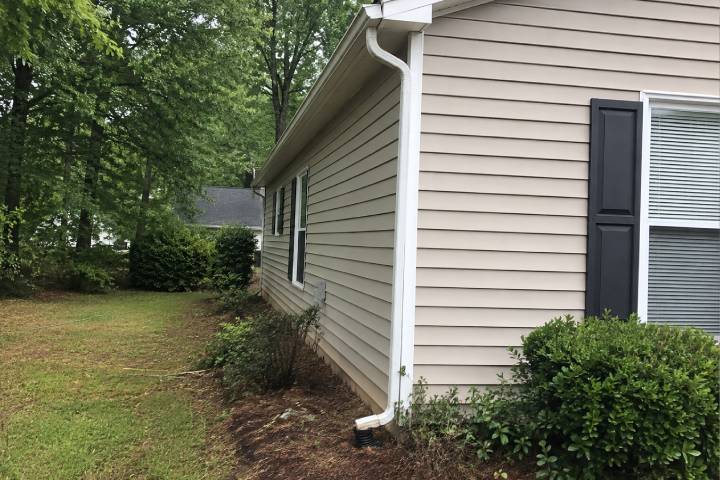
Gutters get most of the blame, but the downspouts attached to them often deserve equal attention. Understanding the downspout failures that start the chain is just as important as understanding gutter overflow, because a clogged or disconnected downspout can dump an entire roof's worth of water into one small area near the foundation in minutes.
Homes in the Green Street Historic District of Gainesville, with their tall roof pitches and long downspout runs, are especially prone to this. A disconnected elbow at ground level can send water pooling right where a crawl space vent sits nearby. That is one reason downspout services matter as much as cleaning the gutters themselves. A downspout that empties two feet from the foundation instead of six feet away can undo all the benefit of a freshly cleaned gutter system, and a short extension is often the entire fix.
Winter Rains and the Repeating Cycle
Late fall and winter in Georgia bring slow, soaking rains rather than the quick summer downpours homeowners are used to watching for. These extended rain events are exactly the kind that keep saturating the same strip of soil day after day, because gutters that are already struggling with fallen leaves have no chance to recover between storms.
This is the season when most people are not thinking about their gutters at all, which is precisely why the cycle keeps running unnoticed. A clogged system in November can quietly feed moisture into a crawl space clear through February, long before anyone connects the dots between a rainy season and a musty smell that will not go away. Left alone, that slow saturation becomes the baseline condition of the crawl space rather than an occasional nuisance.
Local Symptoms Across Georgia Homes
Different parts of the state show this pattern in slightly different ways, but the underlying cause stays consistent. Around Columbus, particularly near Lakebottom, older homes with mature landscaping often see gutters overwhelmed by both leaves and pine debris, which accelerates the overflow problem well before winter rains even arrive in force.
Routine residential gutter cleaning tends to catch these issues early, before soil saturation has a chance to build. For property owners managing multiple buildings, whether apartment complexes or office parks, commercial gutter cleaning serves the same purpose at a larger scale, protecting foundations across an entire site rather than a single home. When damage has already occurred, whether it is a sagging section or a seam that has split open, gutter repair addresses the structural failure directly rather than just clearing debris. Catching these problems early keeps the whole chain, from roofline to crawl space, from ever getting started, and it spares homeowners the more expensive moisture remediation work that follows months of neglect.
Breaking the Cycle Before Spring
The good news is that this entire chain reaction is preventable, and it does not require guesswork about what your gutters are doing right now. A quick satellite assessment can produce a free estimate without anyone needing to climb a ladder first, giving homeowners a clear picture of gutter condition before committing to any work. Once a plan is in place, vetted local pros handle the job, including work on ladders, rooflines, and older fascia boards that need careful handling. Many homeowners in our network choose seasonal spring and fall plans so gutters get attention right before the two heaviest debris seasons each year, rather than waiting until a musty smell forces the issue. After each cleaning or repair, before and after photos get emailed the same day, so there is a clear record of what changed and why. And because clogs are the root of so many of these crawl space problems, the 45-day no-clog guarantee gives homeowners real breathing room heading into the wettest months, backed by a promise rather than a hope. Breaking the cycle starts above the ground, and once the water is managed there, the crawl space below finally gets the chance to dry out and stay that way.