
Coastal Georgia homeowners already know the sound of rain hitting a metal roof, but hurricane season brings a different kind of water problem entirely. When a tropical system moves through, it doesn't just rain harder. It rains sideways, in bursts that overwhelm a gutter system that handled every ordinary thunderstorm just fine.
Getting ahead of that reality means thinking about your gutters differently starting in late summer, not waiting until a storm is already named and tracking toward the coast.
Why August Marks the Real Start of Coastal Risk
The Atlantic hurricane season officially runs June 1 to November 30, but along the Georgia coast the real threat window tightens up considerably. Late August through October is when sea temperatures peak and storm tracks most often bend toward the southeastern seaboard. Homeowners in Savannah's Ardsley Park and further south in St. Simons Island tend to see their most damaging weather cluster inside those ten weeks. That makes right now, before the peak window opens, the smartest time to get ahead of gutter maintenance rather than scrambling once a storm shows up on a forecast map.
| Period | Risk Level | Note |
|---|---|---|
| June 1 to Aug | Season starts | Official Atlantic hurricane season begins |
| Late Aug to Oct | Peak risk | Sea temps peak, storms track toward coast |
| Nov 30 | Season ends | Official close of hurricane season |
| Before peak window | Best prep time | Ideal time for gutter maintenance |
What Tropical Rain Bands Do That Ordinary Storms Don't
A regular summer downpour drops rain fast but usually straight down. Tropical rain bands are different. Wind-driven water hits rooflines at an angle, pushes under shingles at the edges, and forces gutters to handle volumes they were never really tested against in a normal year. This is wind-driven water behaving nothing like a typical thunderstorm, and it exposes weak seams and joints that never get tested any other time of year. Add in the fact that coastal humidity is already working against your gutter system long before a storm arrives, and you start to see why prep matters. It's worth understanding what coastal humidity already does to Savannah gutters before you even factor in wind and rain bands, because a system already weakened by ongoing moisture exposure has far less capacity left when a tropical system rolls in.
Cleaning Before a Storm Has a Name
Here's the part homeowners underestimate every single year: once a storm gets a name and a forecast cone, every reputable crew on the coast books up within days. Waiting until you see a system forming in the Atlantic is waiting too long. The smarter move is scheduling residential gutter cleaning in the weeks before peak season even opens, so your system starts the window clear rather than already half full. A vetted pro in our Savannah network has said the same thing every year: the calls that come in the day before landfall are the ones that simply can't be helped in time. Clean gutters going into a storm aren't a luxury. They're the difference between water draining where it should and water intrusion finding its way into a soffit or fascia board instead.
Downspout Straps and Hanger Checks Before the Wind Arrives
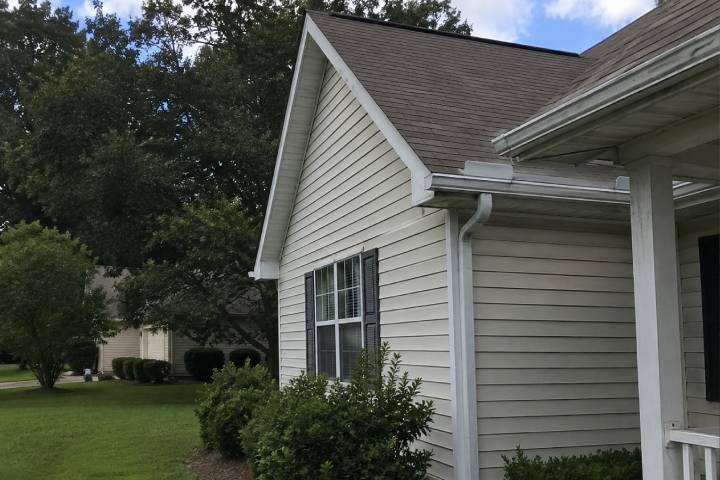
Clogged gutters get most of the attention, but downspouts are often the weaker link during an actual storm. Straps and hangers loosen over time from heat cycling and coastal salt air, and they can work themselves free without ever showing an obvious sign until wind-driven rain arrives and the whole system has nowhere to send water except back toward the roofline or the foundation. This is exactly why downspouts that fail in heavy storms cause more property damage than clogged troughs ever do. A quick check of every strap and hanger, especially on homes near Brunswick's Old Town where older housing stock means older hardware, catches problems while there's still time to fix them. If a downspout looks loose or is pulling away from the wall, that's a job for proper downspout services rather than a temporary fix with a zip tie.
Roof Valleys Collect More Than You'd Think
Roof valleys funnel water toward gutters, but they also funnel debris right along with it. During tropical weather, that debris arrives all at once instead of gradually. Palm litter, live oak leaves, and Spanish moss get thrown into valleys and gutters in a single storm cycle in a way that a normal rainy week never produces. Homes shaded by heavy oak canopy, common throughout Ardsley Park and much of the Georgia coast, are especially prone to valley buildup right before a storm even makes landfall. A valley packed with wet moss and leaf litter can back water up under shingles fast, so checking valleys is just as important as checking the gutters themselves.
After the Storm Passes, Even a Near Miss
Not every storm makes a direct hit to be worth worrying about. Even systems that stay offshore or brush past the coast can dump enough rain and debris to clog a gutter system within a single afternoon. Homeowners on St. Simons Island often assume a storm that missed them directly means no follow-up is needed, but that's rarely true once wind bands have passed through. A post-storm check should look for compressed debris, bent or pulled sections, and any spot where water clearly overflowed rather than draining. If straps loosened or seams pulled apart during the wind, that's the time to call in gutter repair before the next system in the pipeline has a chance to make it worse. Waiting until the next storm is already forming means starting from behind again.
Coastal Materials That Clog Fast: Palms, Oaks, and Moss
What makes coastal Georgia different from inland parts of the state isn't just wind exposure, it's what falls into the gutters in the first place. Palm fronds shred into fibrous litter that mats quickly when wet. Live oak leaves are dense and slow to break down. Spanish moss holds water like a sponge and can add real weight to a gutter run once it's saturated. Put a tropical system through a neighborhood with all three, and a gutter that was clear a week earlier can be packed solid by the time the rain bands move on. This heavy debris load is one reason coastal homes tend to need more frequent attention during the June through November season than homes further inland, where accumulation simply isn't as fast or as dense.
Building a Season-Long Plan Instead of a Storm-by-Storm Scramble
The homeowners who handle hurricane season with the least stress aren't the ones reacting to every storm that pops up on a map. They're the ones with a plan already in place before June even arrives. That's true for single-family homes and it's just as true for property managers handling commercial gutter cleaning across multiple coastal buildings, where a missed cleaning can mean water damage across several units instead of just one. A solid seasonal approach usually includes a 45-day no-clog guarantee so a single cleaning actually holds up through the wettest stretch of the year, along with free estimates from satellite imagery that let a homeowner get a clear picture of their roofline without waiting on a scheduling gap. Pairing that with before and after photos emailed the same day gives property owners documentation without having to be on site, and working with licensed and insured local pros on a spring and fall plan means the system is ready well before the peak window opens in late August. That's the kind of preparation that turns hurricane season from a scramble into something manageable, storm after storm.