
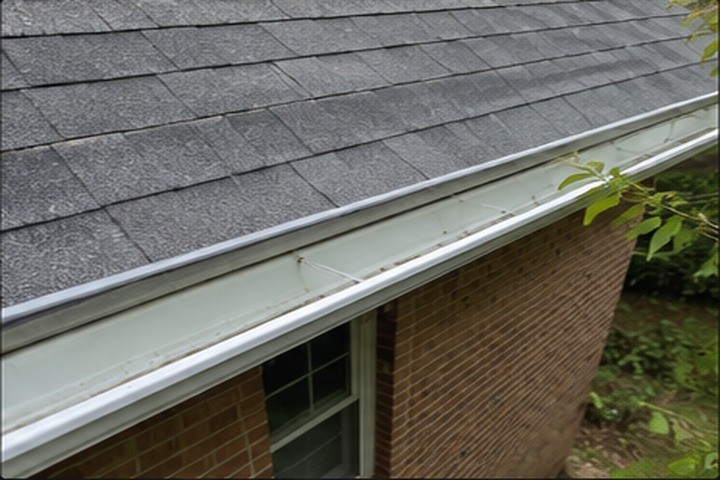
Stand in the driveway, look up at the gutters, and if nothing is sprouting or spilling, it is natural to assume all is well. This quick visual check is how most Georgia homeowners decide their gutters are fine, often for years at a stretch. Unfortunately, it is also one of the least reliable inspections you can do.
Gutters are built to hide their contents from exactly the angle you view them from below. A channel can look perfectly clean from the ground while holding enough packed debris to fail at the next heavy rain.
The False Comfort of a Curbside Glance
From below, you see the outer face of the gutter and almost nothing of what lies inside it. The lip of the trough sits between your eye and the channel, hiding the entire bottom from view. The angle works against you, showing the one surface least likely to reveal a problem. In Atlanta's Candler Park, plenty of homes with spotless-looking gutters turn out to be holding a dense layer of sludge once someone actually looks in.
A clean exterior says nothing about the interior. The face can stay tidy while the channel behind it fills steadily, season after season.
What Actually Hides Below the Rim
The material that causes real trouble settles at the very bottom of the trough, exactly where the rim conceals it. Decomposed leaves, pollen sludge, and roof grit pack into a low layer that water cannot move through. The worst buildup sits lowest, in the blind spot a ground view can never reach. A homeowner in Marietta near Kennesaw might be astonished to learn their pristine-looking gutters hold inches of compacted debris.
This hidden layer is also the densest and heaviest part of any blockage. Compacted sediment does not shift or show itself, which is precisely what makes it dangerous.
Even homes with nothing overhead fail this test, as why Georgia gutters clog even when there are no trees over the roof makes clear.
Why the Clog Builds Out of Sight
Gutter blockages do not start at the top where you might notice them; they start at the bottom and grow upward. The first debris to arrive settles into the channel floor and begins to compact and decay there. The blockage grows from the base, so by the time it reaches a visible level, the problem is already advanced. In Augusta's Forest Hills, this slow upward build is why so many overflow surprises seem to come out of nowhere.
The visible portion is only ever the tip of the issue. What shows above the rim represents a fraction of what has already accumulated below it.
In North Georgia the deception runs deeper, because matted needles form a false floor. Pine needles are not the only gutter problem in North Georgia, but they hide the rest well.
The Problems That Stay Silent
A gutter that looks clean can still be rotting the fascia behind it, breeding mosquitoes, or corroding from the inside. None of these announce themselves to a glance from the lawn. Hidden moisture damage can progress for a long time before any outward sign appears. A home in Athens's Cobbham district might show no symptoms at all right up until a section sags or a board gives way.
By the time a silent problem becomes visible, it is usually no longer cheap to fix. Early-stage damage is exactly the kind a ground-level inspection is least equipped to catch.

The Limits of Even a Careful Look
Some homeowners go further than a glance, walking the perimeter and studying each run closely. That diligence is admirable, but it still cannot overcome the basic geometry of the situation. No vantage from the ground lets you see over the rim and into the channel. Binoculars and phone cameras on poles help a little, yet they rarely reveal the true depth of what is settled at the bottom.
The only reliable view is from the level of the gutter itself. Seeing into the trough requires getting up to it, which is where a proper inspection begins.
| Viewing Method | What You See | What You Miss |
|---|---|---|
| Ground level glance | Outer face of gutter | Entire interior channel |
| Walking the perimeter | Closer view of outer face | Depth of bottom debris |
| Binoculars or phone pole | Slightly more detail | True depth of buildup |
| Roofline inspection | Full interior of channel | Nothing, confirms real condition |
What a Real Inspection Reveals
Getting eyes on the inside of the channel changes the picture entirely. From the roofline, the depth of sludge, the condition of the seams, and the state of the downspout openings all become clear. An interior view turns guesswork into facts about what the system actually needs. This is the difference between hoping the gutters are fine and knowing it.
That knowledge also prevents unnecessary work, since a genuinely clean gutter can be confirmed rather than cleaned on a hunch. An honest assessment tells you what is required and what is not.
How a Pro Sees What the Ground Hides
A professional inspection brings the view you cannot get from below, and then documents it so you do not have to take anyone's word for it. Before-and-after photos show exactly what was inside the channel and what it looks like once cleared, closing the gap between appearance and reality. A free satellite-based estimate maps the roof and gutter layout so the visit is planned to your home specifically.
Every cleaning the network arranges stands behind the result. The 45-day no-clog guarantee brings a vetted local pro back at no charge if a blockage surfaces soon after the work.
Do Not Trust the View From the Driveway
The reassuring glance up at clean-looking gutters is one of the most common ways Georgia homeowners get caught off guard. What you cannot see from the ground is precisely what determines whether your gutters will hold up in the next storm. A reliable answer requires a look from the level of the gutter, not the lawn.
If it has been a while since anyone actually looked inside yours, it is worth finding out what is really there. Schedule a free estimate for residential gutter cleaning or commercial gutter cleaning, and consider gutter repair or downspout services if a closer look turns up trouble.