
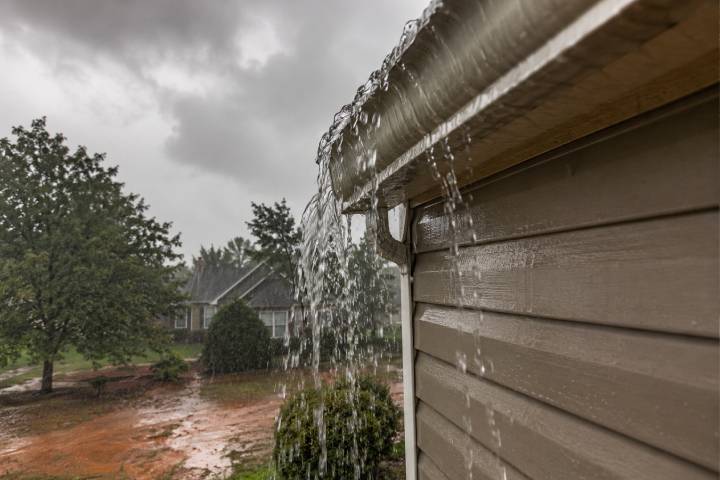
Every Georgia homeowner learns the same lesson eventually, usually after a heavy August storm rolls through and leaves a puddle that just sits there for days. That puddle isn't random. It's a direct result of where your downspouts release water and how the soil underneath handles it.
Sandy soil in coastal Georgia drains fast. The red clay found across most of the state does not. Understanding that difference changes how you should think about every downspout on your roofline.
The Puddle That Never Dries: A Red Clay Problem
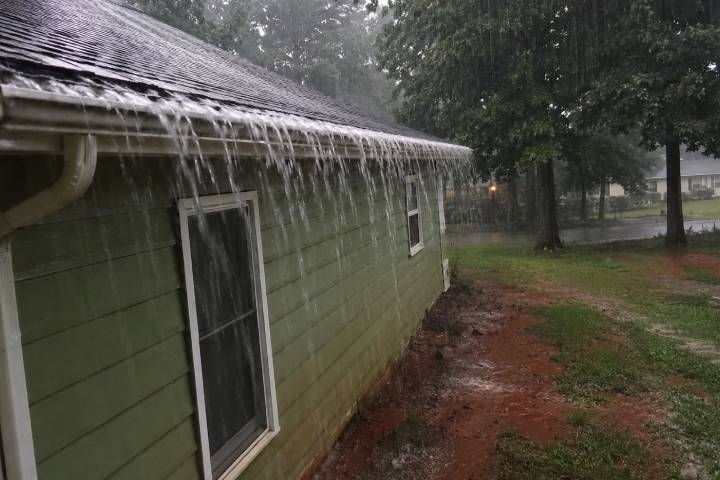
Anyone who has lived in Georgia long enough knows the sight: a low spot near the foundation that stays damp for a week after rain while the rest of the yard dries out in a day. This is a classic symptom of slow soil drainage meeting concentrated roof runoff. Red clay compacts tightly and resists water movement, so any spot where a downspout dumps its load becomes a holding pond instead of a drainage point.
Left unchecked, that standing water doesn't just kill grass. It creates hydrostatic pressure against whatever structure sits nearby, and over time that pressure finds its way through cracks you didn't know you had.
Splash Blocks: Simple but Limited
Splash blocks are the entry-level solution, and they work fine on flat, well-drained lots. In a red clay yard, though, a splash block often just relocates the puddle a foot or two from the wall instead of solving anything. The block breaks the fall of the water, but the water still has nowhere to go once it hits saturated clay.
On sloped lots, especially in parts of metro Atlanta where grading pushes water toward neighboring yards, a splash block alone rarely moves enough volume during a real downpour. It's a starting point, not a finish line, and that's why proper grading matters just as much as the block itself.
Surface Extensions: A Step Up
Flexible or rigid extensions that carry water five to ten feet from the foundation solve more problems than splash blocks do, simply because distance matters in clay soil. The farther the discharge point sits from the slab or crawl space wall, the less chance that water has of migrating back through the soil toward your foundation.
This is especially relevant in older neighborhoods like Kirkwood in Atlanta, where mature trees and established grading sometimes mean the yard slopes back toward the house rather than away from it. A longer extension buys you extra clearance without any digging, which makes it a reasonable middle step before committing to buried pipe.
Underground Options: Buried Pipe and French Drains
For homes where the yard slopes enough to allow it, running corrugated pipe underground to a daylight outlet is often the most reliable fix. The pipe stays hidden below the surface, carries water well past the splash zone, and empties at a point low enough that gravity does the rest of the work. This method shines in yards around Augusta's Summerville area, where rolling terrain gives homeowners the elevation change needed for a true daylight outlet.
Not every lot has that kind of grade, though. Flat lots, or lots where the low point sits uphill of the discharge area, often need a French drain instead, since a gravel-filled trench with a perforated pipe allows water to disperse gradually rather than concentrating at one exit point. French drains take more labor to install correctly, but they solve problems near flat foundations that surface solutions can't reach, and they pair well with gutter repair when the whole system needs a second look after years of neglect.
| Method | Best For | Limitation |
|---|---|---|
| Splash Block | Flat, well-drained lots | Just relocates puddle nearby |
| Surface Extension | Yards needing more distance | No digging but limited reach |
| Buried Pipe | Sloped yards with daylight outlet | Needs enough grade to work |
| French Drain | Flat lots near foundation | More labor to install |
Why Pointing Uphill Toward a Flowerbed Backfires
One mistake shows up again and again across Georgia neighborhoods: a downspout aimed at a flowerbed that sits uphill of the house. It looks tidy from the driveway, but physically it makes no sense. Water poured onto higher ground has only one direction to travel: downhill, straight back toward the foundation it was supposed to avoid.
A vetted pro in our Warner Robins network near Robins Air Force Base has seen this exact setup cause slow crawl space flooding for years before anyone traced it back to the downspout. If you want to understand the mechanics behind this, our breakdown of rainwater draining too close to the foundation covers the long-term damage this kind of misplacement causes. The fix is almost always the same: redirect the discharge downhill, even if that means a longer run of pipe or a repositioned extension away from the planting bed.
Downspouts vs Gutters: What Actually Moves the Water
Homeowners spend a lot of energy worrying about gutters, but during a real Georgia storm the downspouts do the heavier lifting. Gutters just collect. Downspouts decide where thousands of gallons actually go over the course of a season. A clogged or misdirected downspout can undo even a freshly cleaned gutter system in a single storm.
Our article on why downspouts matter more than gutters in a storm goes deeper into this, but the short version is simple: discharge placement matters as much as capacity. Regular residential gutter cleaning keeps the whole system flowing, but it only helps if the water has somewhere sensible to land once it leaves the downspout, which is where overall system design comes into play.
Reading Your Slope Before You Decide
Before choosing any of the methods above, walk your property after a storm and watch where the water actually goes. Many metro Atlanta lots slope enough that roof water can travel straight toward a neighbor's foundation or circle right back to your own, and you won't catch that on a dry day. Note the low points, the slow spots, and anywhere water lingers longer than an hour.
Commercial properties face the same challenge on a larger scale, often with multiple rooflines feeding into shared drainage areas. That's why commercial gutter cleaning often includes a full downspout audit as part of the visit, since one poorly placed discharge point can affect an entire parking lot during peak storm season and cause drainage backups that are costly to trace later.
Getting the Discharge Point Right the First Time
Choosing the right downspout discharge isn't guesswork once you understand how red clay behaves. It's about matching the method, splash block, extension, buried pipe, or French drain, to your yard's actual slope and soil conditions. Getting it wrong doesn't just waste money. It invites the kind of slow, creeping foundation trouble that's expensive to reverse once it starts.
Our network connects homeowners with licensed and insured local pros who assess these details in person rather than guessing from the street. Many offer free estimates from satellite imagery before they even set foot on your property, and every job comes with a 45-day no-clog guarantee plus before and after photos emailed the same day so you can see exactly what changed. If your downspouts need more than a redirect, our downspout services page outlines what a proper regrade or pipe extension typically involves, and seasonal spring and fall plans keep the whole system checked before Georgia's heaviest rains arrive each year.