
Plenty of Georgia homeowners assume a roof with no branches hanging over it is a roof that will never need gutter work. It is one of the most common beliefs we run into, and it usually surfaces right after a heavy rain sends water sheeting over the front porch. A clear sky above your shingles does not mean clear channels along your eaves.
Across metro Atlanta and down into the coastal plain, overflow on tree-free roofs shows up almost as often as it does under heavy canopy. The reasons have less to do with what hangs above your house and more to do with what Georgia's air, wind, and weather quietly deposit week after week.
The Debris You Never See From the Driveway
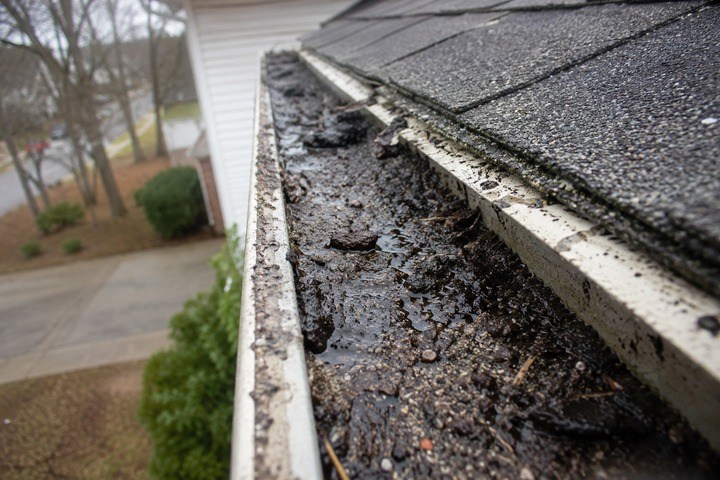
Standing in the yard, your gutters can look completely empty while holding a dense layer of material packed below the lip of the trough. Fine debris settles and compacts long before any leaf arrives, forming a mat that water cannot pass through. At one home in Marietta's East Cobb area, the gutters looked spotless from the lawn yet held nearly an inch of paste-like grit along every run.
That hidden layer is the part most people overlook because it never spills over the front edge where you would notice it. The clog builds from the bottom up, which is exactly why a ground-level glance gives such a false sense of security.
| Debris Source | What It Leaves Behind | Where It's Common |
|---|---|---|
| Hidden grit | Paste-like layer below lip | Any tree-free roof |
| Wind-blown litter | Pine tassels, seed pods | Roswell, Savannah coastal areas |
| Shingle granules | Coarse black grit | South-facing slopes |
| Pollen | Mud-like, cement-hard layer | Metro Atlanta in spring |
How Georgia Wind Moves Debris Onto Bare Roofs
Your roof does not need its own trees to collect organic litter. A single gusty afternoon can carry pine tassels, oak catkins, and dried seed pods from a neighbor's yard two or three lots away and drop them squarely into your troughs. Spring storms are especially efficient at this, sweeping lightweight debris off dozens of surrounding properties and funneling it toward whatever gutters sit downwind. In Roswell's Historic District, where mature hardwoods line nearly every street, even homes with bare roofs fill up within a season.
Coastal neighborhoods see the same pattern with different material. Salt-laden breezes off the marshes push live-oak leaves and Spanish moss fragments into gutters all over Savannah's Isle of Hope, whether or not a tree actually overhangs the house.
Your Shingles Are Quietly Shedding Into the Gutters
Every asphalt roof loses its mineral surface gradually across its lifespan, and all of that grit washes straight down into the gutters with each rain. Roof grit looks like coarse black sand, and it builds fastest on south-facing slopes that bake under the Georgia sun. A homeowner in Macon's Ingleside neighborhood was certain something was wrong with the roof itself, when the dark sludge was simply years of shed granules settling at the low end of every run.
Older roofs shed more, so the problem compounds at exactly the stage when gutters tend to be neglected. Granule buildup holds water like a sponge, adding weight that can pull fasteners loose over time.
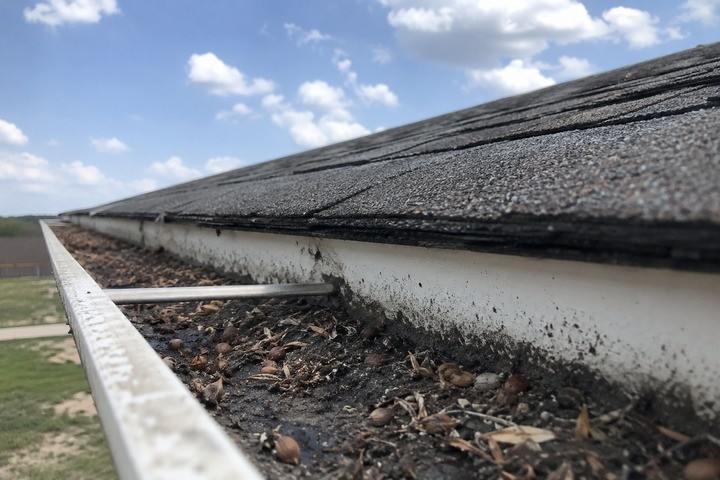
Those dark granules are one of three warning signs every homeowner should know, and our guide to gutter sludge, roof grit, and black streaks explains how to read each one.
Pollen Season Turns Dust Into Concrete
Few states get coated in pollen the way Georgia does, and that yellow-green haze does not just settle on your car. It gathers in gutters as a fine powder, then the first spring rain binds it into a dense, mud-like layer that sets up almost like mortar. Pollen sludge is remarkably heavy once saturated, and it clings to the trough floor in a way loose leaves never do. Homeowners around Atlanta's Virginia-Highland often tell us their gutters overflowed for the very first time the April after a record pollen count.
The trouble is that none of it leaves an obvious pile to spot from below. A tree-free roof offers no defense here at all, since pollen travels for miles on the wind and settles everywhere equally.
What Tree-Free Roofs Still Need Each Season
Skipping maintenance because nothing overhangs the house is the single most expensive assumption a Georgia homeowner can make. Twice-yearly cleaning, in spring and fall, keeps the hidden grit and pollen layers from ever reaching the point of overflow. Our seasonal maintenance plans are built around exactly this rhythm, timed to follow Georgia's pollen surge and its autumn debris drop.
Knowing what is actually sitting in your gutters takes a proper look from the roofline, not a guess from the lawn. A free satellite-based estimate lets the pros in our network size up your roof and gutter layout before they ever arrive, so the quote you get is accurate from the start.
How the Job Gets Confirmed, Not Just Promised
Because the worst gutter debris hides where you cannot see it, proof matters far more than reassurance. Before-and-after photos land in your inbox after every visit, showing the packed grit that came out and the clear channels left behind. It is the same documentation a homeowner in Augusta's Summerville district leaned on to finally settle a long-running debate about whether the gutters were ever truly clogged.
Every cleaning we connect you with is backed by a real commitment rather than a hopeful handshake. The 45-day no-clog guarantee means that if a blockage returns inside that window, a vetted local pro comes back and clears it at no charge.
And if spring left a yellow film on every car in the driveway, it left something worse in the troughs. The hidden gutter problem after Georgia's pollen season picks up that story.
Clear Gutters, No Guesswork
A roof with no trees over it is not a roof that maintains itself, and Georgia's pollen, wind, and shingle grit make sure of that. Seasonal cleaning is the cheapest insurance against the water damage that bare-roof homeowners routinely skip. Whether you need a one-time clear-out or a standing plan, explore residential gutter cleaning or commercial gutter cleaning for larger rooflines.
If overflow has already begun staining your siding or pooling near the foundation, the fix may involve more than cleaning, which is where gutter repair and downspout services come in. Book a free, satellite-based estimate today and find out what is really sitting in your gutters.